marketing(2026)
A practical, actionable overview of marketing fundamentals, channels, and strategies to grow your brand.
marketing is not a single tactic. It’s a disciplined approach to building awareness, trust, and demand for your product or service. In this guide, you’ll find a clear, actionable framework you can apply whether you’re a startup founder, marketing manager, or solo entrepreneur. We’ll cover audience definition, positioning, channel mix, measurement, and practical steps you can implement today.
Audience profiling options across segments
| Segment | Primary characteristic | Research method | Example persona |
|---|---|---|---|
| New founders | Limited brand awareness | Short surveys, quick interviews | "First-time founder" |
| SMB owners | Time-constrained, practical | Online polls, email feedback | "Busy owner" |
| Enterprise buyers | Stakeholder-driven | Workshops, analyst reports | "Procurement committee" |
| Tech enthusiasts | Early adopters | Social listening, beta tests | "Early adopter" |
| B2C moms/parents | Need for trust | Community polls, reviews | "Trust-seeker mom" |
Compiled November 2026; check the provider's site for current details.
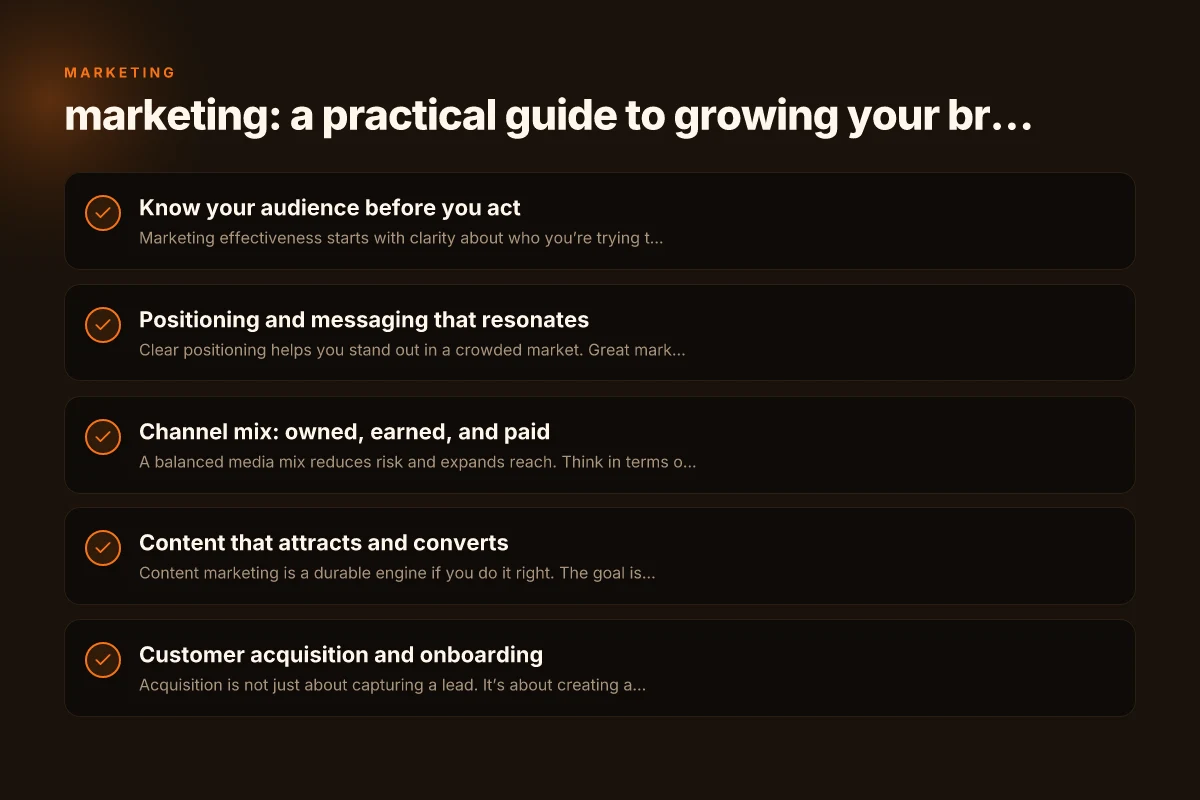
Know your audience before you act
Marketing effectiveness starts with clarity about who you’re trying to reach. If you don’t know your audience, you’re shooting in the dark.
- Create detailed buyer personas: demographics, pains, goals, and decision drivers.
- Map the customer journey: awareness, consideration, purchase, loyalty.
- Prioritize segments: focus on the few segments with the highest impact and clarity of message.
- Gather insights from real customers: interviews, surveys, reviews, and social conversations.
- Define your value proposition: what makes your offer uniquely better for each segment.
A well-defined audience guides every other decision, from messaging to channel selection and budget allocation.
Positioning and messaging that resonates
Clear positioning helps you stand out in a crowded market. Great marketing communicates a simple, credible reason to choose you.
- Craft a positioning statement: for whom, what problem, how you uniquely solve it, and why it’s better.
- Write core messaging pillars: the main benefits, proof points, and a one-liner that lands.
- Align tone and voice with audience expectations: professional, friendly, witty, expert, consistency matters.
- Use social proof: case studies, testimonials, and data-backed results.
- Avoid jargon and feature bloat: lead with outcomes your audience cares about.
Your positioning should be tested and refined as you learn more about what resonates. genre(2026)
Channel mix: owned, earned, and paid
A balanced media mix reduces risk and expands reach. Think in terms of three broad categories:
- Owned channels: your website, blog, email list, mobile app, and social profiles you control.
- Earned channels: publicity, influencer mentions, user-generated content, search engine rankings through quality content, and reviews.
- Paid channels: search ads, social ads, display, and sponsorships.
A simple framework to start:
- Start with owned assets: optimize your site for conversions, build an email list, publish regular content.
- Grow earned attention: SEO-friendly content, PR efforts, partnerships, and customer advocacy.
- Use paid amplification: test small, measurable campaigns to accelerate reach and gather data.
Table: example channel mix for a small SaaS launch
| Channel type | Example | Goal | Typical KPI |
|---|---|---|---|
| Owned | Website, blog, email list | Build audience and convert | Traffic, signups, CTR to trial |
| Earned | Earned media, SEO, reviews | Credibility and long-tail traffic | Media mentions, organic search rankings, reviews |
| Paid | Search ads, social ads | Accelerate reach and scale | CPA, ROAS, trial signups |
Tip: start with a 60/30/10 ratio (owned to earned to paid) for the first quarter, then adjust based on results. editing(2026)
Content that attracts and converts
Content marketing is a durable engine if you do it right. The goal is to educate, inspire, and convert without being pushy.
- Map content to stages: awareness content (comprehensive guides), consideration (how-to tutorials, comparisons), decision (case studies, ROI calculators).
- Use a consistent publishing cadence: weekly blog post, monthly resources, quarterly webinars.
- Optimize for SEO: keyword research, intent matching, internal linking, and user-focused headlines.
- Create formats that perform: long-form guides, videos, templates, checklists, and calculators.
- Repurpose efficiently: turn a webinar into a blog post, a slide deck into an infographic, a case study into social posts.
A strong content operation reduces dependence on paid media and builds lasting organic visibility.
Customer acquisition and onboarding
Acquisition is not just about capturing a lead. It’s about creating a smooth, values-aligned path to activation and retention.
- Map the funnel: awareness, interest, consideration, conversion, activation.
- Use lead magnets that align with your audience’s needs: templates, benchmarks, or free trials.
- Optimize the landing experience: minimal friction, clear benefits, social proof, and a strong CTA.
- Align onboarding with value delivery: show early outcomes, provide guided tours, and offer helpful resources.
- Measure activation rate and time-to-value: how quickly a user achieves a meaningful outcome.
A tight onboarding experience increases CLV and reduces churn, making your marketing more effective over time. book cover(2026)
Messaging options by positioning strategy
| Positioning angle | Core message | Proof source | Tone | Channels | KPI hint |
|---|---|---|---|---|---|
| Value-based | Save time, boost revenue | Case studies, ROI | Practical | Website, emails | Conversion rate |
| Differentiation | Unique feature claim | Demos, benchmarks | Confident | Demos, webinars | MQL rate |
| Social impact | Sustainability, ethics | Certifications, audits | Transparent | PR, social | Brand lift |
| Convenience | Easy setup, fast wins | Onboarding guides | Friendly | Tutorials, SEM | Activation rate |
| Reliability | Consistency, uptime | SLAs, uptime data | Steady | Support, docs | Retention rate |
Compiled November 2026; check the provider's site for current details.
Measurement, analytics, and learning loops
Marketing without measurement is guesswork. Build a data-informed culture that learns fast.
- Define a small, actionable set of KPIs: traffic quality, lead quality, conversion rate, activation rate, and revenue contribution.
- Use a funnel model: analyze input (impressions, clicks), mid-funnel (engagement, MQLs), and output (opportunities, revenue).
- Run experiments (growth loop): hypothesis, test, measure, learn, and scale.
- Track attribution thoughtfully: multi-touch models often beat last-click. Assign credit across touchpoints.
- Establish a weekly cadence: review dashboards, discuss insights, and decide on next tests.
A disciplined measurement approach helps you allocate budget to the tactics that move the needle. book writing(2026)
Budgeting and resource planning for marketing
Smarter spending beats bigger budgets when you’re starting out. The goal is to maximize ROI with limited resources.
- Set a clear annual budget aligned to business goals.
- Break it down by channel: a small, testable reserve for experimentation.
- Plan resource needs: content creators, designers, developers, and analysts.
- Build a calendar: content, campaigns, product launches, and seasonal opportunities.
- Prioritize initiatives with high impact and data-backed potential.
As you scale, increase reserves for proven channels but maintain a bias toward learning and optimization.
A practical 30-day action plan
If you’re launching or reorganizing marketing, try this concrete plan:
- Week 1: define audience and positioning. Create two buyer personas, a simple value proposition, and a one-page messaging guide.
- Week 2: audit owned assets. Improve your website look and feel, optimize your homepage hero, and set up essential tracking (GA, conversion events). Start a weekly content calendar.
- Week 3: outline 3 content formats. Produce one core blog post, one how-to video, and one checklist or template. Launch an initial email sequence for new subscribers.
- Week 4: run one small paid test. Use a tight target audience, limited budget, and pick one metric to optimize (e.g., CPA or signups). Review results, iterate.
If you have more time, add a PR or influencer outreach pilot, and publish a customer success story. pricing(2026)
Channel mix selection matrix
| Channel type | Cost to acquire | Reach scale | Credibility | Lead quality | Tracking ease | Recommended focus |
|---|---|---|---|---|---|---|
| Owned media | Low to moderate | High | Moderate | Moderate | High | Content and SEO |
| Earned media | Low to high | Moderate | High | High | Low | PR, influencers |
| Paid media | Variable | High | Moderate | Variable | High | Tests and scale |
| Partnerships | Moderate | Niche | High | Moderate | Medium | Co-branded campaigns |
| Events/webinars | Moderate | Moderate | High | High | Medium | Thought leadership |
Compiled November 2026; check the provider's site for current details.
Common pitfalls to avoid
- Vague audience definitions: “everyone” is not a value proposition.
- Inconsistent messaging: different parts of your team speak differently.
- Over-reliance on vanity metrics: traffic without quality, leads, or revenue impact.
- Ignoring onboarding: a nice signup is not a win if users don’t activate.
- Underinvesting in measurement: you can’t optimize what you don’t track.
Avoid these by keeping a tight feedback loop and always tying activity to business outcomes.
Final recommendation
Marketing thrives on clarity, discipline, and a willingness to learn quickly. Start with a sharp audience definition and a clear value proposition. Build a modest, balanced channel mix focusing first on owned and earned media to establish credibility and foundation. Use paid tactics sparingly to learn and accelerate, not to mask weak fundamentals. Create a simple measurement framework, run small experiments, and iterate. If you do these things consistently, you’ll move from random campaigns to a repeatable, scalable system that drives growth. publishing(2026)