book writing(2026)
A practical, step-by-step guide to book writing from idea to publication, with actionable tips and timelines.
Writing a book can feel like a daunting quest, but with a clear map and steady habits, you can move from idea to published work. This guide lays out a practical path for book writing, covering idea validation, planning, drafting, revising, and finally publishing. Whether you’re chasing a novel, a nonfiction guide, or a memoir, the core steps remain the same: know your audience, outline your structure, commit to a routine, and invest in editorial polish.
Compare idea validation criteria
| Criterion | Need validation? | Best method | Indicators |
|---|---|---|---|
| Market demand | yes | surveys, keyword research | demand signals, search volume, reader interest |
| Unique angle | yes | competitor map | distinct value, fresh perspective |
| Author credibility | yes | track record, samples | credibility cues, author background |
| Feasibility | yes | time/cost estimate | realistic timeline, budget |
| Scope fit | yes | one-sentence premise | focused or too broad |
| Potential longevity | yes | trend vs evergreen | evergreen appeal or fad |
Compiled November 2026; check the provider's site for current details.
Idea validation: does the book have legs?
Before you dive in, test whether your concept has a ready audience and a viable shelf life.
- Define your audience: who will read this book, and what problem or curiosity will it address?
- Clarify the core promise: what will readers gain from your book that they can’t get elsewhere?
- Assess market fit: skim similar titles, note what they did well, and identify gaps you can fill.
- Validate with a mini-moutain of proof: outline a chapter, write a sample scene or section, and gather feedback from a trusted reader.
A short, concrete validation exercise can save months of work if the concept isn’t resonating. If your idea passes the test, move to planning with confidence.
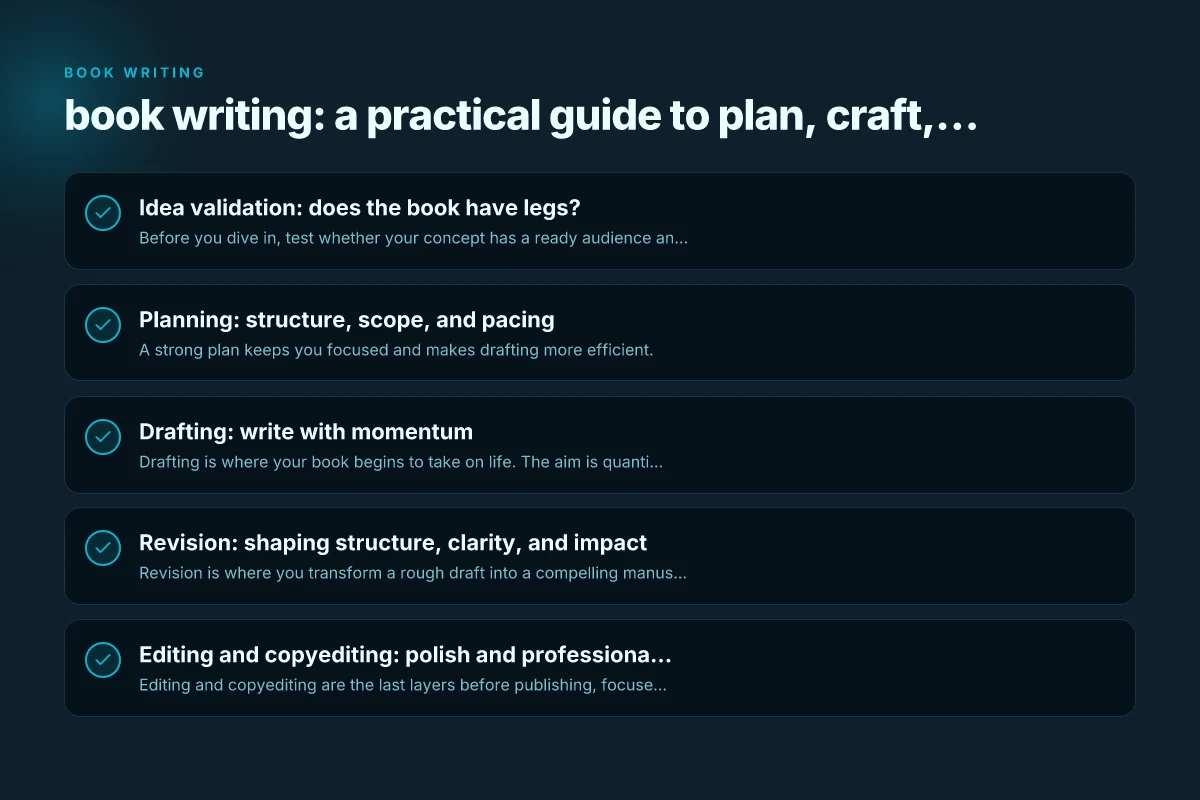
Planning: structure, scope, and pacing
A strong plan keeps you focused and makes drafting more efficient.
Create a blueprint
- Choose your book type: novel, nonfiction guide, memoir, or hybrid.
- Define the spine: the core structure (e.g., act structure for fiction, three-part framework for nonfiction).
- Draft a table of contents (TOC): list chapters without getting lost in prose.
- Set your word count and deadline: a realistic target helps sustain momentum.
Outline methods that fit you
- The chapter-by-chapter outline: summarize each chapter in a paragraph.
- The scene list for fiction: outline key scenes, turning points, and character arcs.
- The argument map for nonfiction: map chapters to the central thesis, evidence, and takeaways.
Schedule and milestones
- Create a writing calendar with weekly word goals.
- Plan for revision sprints after finishing a draft.
- Build time for feedback, editing, and proofreading.
A solid plan reduces paralysis and makes the writing process measurable rather than mysterious. editing(2026)
Drafting: write with momentum
Drafting is where your book begins to take on life. The aim is quantity and then quality.
Develop a sustainable routine
- Establish a daily or weekly writing ritual, even if it’s shorter at first.
- Protect deep-work windows free from distractions.
- Use a timer (e.g., 25-minute sprints with a 5-minute break) to build consistency.
Focus on getting the story down
- Don’t over-edit as you go. The first draft is about exploring ideas and shaping the narrative.
- Prioritize clarity and voice over flawless prose in the draft.
- If you get stuck, switch to another chapter or perform a quick writing sprint to unstick.
Track progress
- Keep a visible progress log: days written, words produced, scenes completed.
- Celebrate small wins to sustain motivation.
- If you miss a target, adjust your plan rather than abandon it.
A productive draft is a balance between momentum and intent. You want to produce enough material to test the idea while keeping room for later refinement.
Compare drafting and revision workflow
| Stage | Time required | Key activity | Output quality signal |
|---|---|---|---|
| Drafting | short/medium | free writing, momentum | first complete manuscript draft |
| Self-review | short | read aloud, notes | major gaps identified |
| Revision pass | medium | restructuring, clarification | stronger structure, flow improved |
| Line editing | short | sentence-level polish | clarity and rhythm improved |
| Copyedit readiness | short | consistency check | polished, error-free text |
Compiled November 2026; check the provider's site for current details. genre(2026)
Revision: shaping structure, clarity, and impact
Revision is where you transform a rough draft into a compelling manuscript.
Big-picture edits
- Revisit the spine: does the book stay on message and deliver the promised value?
- Check pacing and arc: ensure rising tension, clear stakes, and satisfying outcomes.
- Confirm character motivations or thesis support across chapters.
Line edits and language
- Tighten sentences, choose precise words, and remove redundancies.
- Vary sentence length for rhythm. Use active voice where appropriate.
- Replace clichés with concrete, fresh phrases.
Feedback and iterative cycles
- Gather feedback from beta readers, writing groups, or a professional editor.
- Implement changes in cycles: big-picture edits, then line edits, then a final pass.
- Create a revision checklist to avoid missing important tweaks.
Nonfiction-specific refinements
- Strengthen arguments with evidence, case studies, and examples.
- Clarify takeaways and actionable steps for readers.
- Ensure consistency of tone, terminology, and layout.
A thorough revision process can dramatically elevate the readability and authority of your book.
Editing and copyediting: polish and professionalism
Editing and copyediting are the last layers before publishing, focused on accuracy, consistency, and readability.
- Copyediting checks: grammar, punctuation, hyphenation, and typographical consistency.
- Fact-checking: verify dates, statistics, and sources for nonfiction.
- Consistency review: ensure voice, terminology, and formatting are uniform.
- Formatting: align with publishing standards, including chapters, headings, fonts, and margins.
If you plan to self-publish, you’ll most likely require a professional editor and a proofreader. If you pursue traditional publishing, your agent and editor will guide this phase, but be prepared to engage with multiple rounds of edits. marketing(2026)
Publishing paths: choose your route
There are several viable routes to getting your book into readers’ hands. Each has pros and cons, depending on your goals and resources.
- Traditional publishing: requires an agent, a strong proposal or manuscript, and a willingness to accept more control in exchange for broader distribution and professional support.
- Self-publishing (print and/or eBook): offers speed and creative control, with higher upfront costs and responsibility for cover design, formatting, and marketing.
- Hybrid publishing: blends elements of traditional and self-publishing, often with a professional team and paid services.
Here’s a quick comparison to help decide where you might invest your energy:
Comparison table
Criterion: Timeline pricing(2026)
Traditional: Long lead time (months to years) but potential ongoing royalties
Self-publishing: Fast to market (weeks to months)
Hybrid: Moderate timelines, depending on services chosen
Criterion: Control publishing(2026)
Traditional: Lower control, editorial direction from house
Self-publishing: Full control over content and design
Hybrid: Moderate control, with some editorial support
Criterion: Marketing support
Traditional: Strong, via publisher networks
Self-publishing: Largely self-driven marketing
Hybrid: Shared marketing responsibilities with provider
Criterion: Costs and royalties
Traditional: Lower upfront costs, royalties after advances
Self-publishing: Upfront costs for design, formatting, and distribution. Royalties go to you
Hybrid: Varies, often shared costs with service providers
Criterion: Best for
Traditional: Authors who want wide distribution and are comfortable with a gatekeeper
Self-publishing: Authors who want speed, control, and a higher share of royalties
Hybrid: Authors seeking a middle path with professional guidance
Compare publishing paths
| Path | Access level | Typical timeline | Output requirements | Pros | Cons |
|---|---|---|---|---|---|
| Traditional publishing | broad reach | long | full manuscript, proposal | prestige, support | gatekeeping, slower |
| Hybrid publishing | moderated reach | medium | contract, upfront costs | control + support | cost risk, variable quality |
| Self-publishing | immediate | fast | manuscript, formatting | rapid, full control | marketing on you, costs |
| Serialized / indie | niche reach | variable | chapters, metadata | audience building | fragmented release |
| Small press | moderate reach | medium | submission package | supportive editors | slower than self-pub |
Compiled November 2026; check the provider's site for current details.
Publishing logistics: getting it out there
Once you have a solid manuscript, you’ll need to handle the practicalities of publication.
- Cover design and interior layout: a professional, genre-appropriate design attracts readers and supports readability.
- Metadata and cataloging: choose a clean title, subtitle, keywords, and categories to maximize discoverability.
- ISBNs and distribution: decide on platforms (Amazon, Apple Books, Google Play, etc.) and obtain necessary ISBNs.
- Marketing plan: build an author platform, prepare launch materials, schedule promotions, and gather reviews.
Marketing is not an afterthought. A thoughtful plan that aligns with your audience can dramatically increase discoverability and sales.
The final recommendation: start with a concrete, achievable plan
If you take one thing away from this guide, let it be this: success in book writing comes from two things, clarity of purpose and steady, disciplined execution. Start by validating your idea to ensure there is an audience and a clear promise. Then, build a practical plan with a timetable, a TOC, and writing goals. Draft with momentum, then revise with intention, relying on feedback and professional editing to sharpen your manuscript. Finally, choose a publishing path that fits your goals, followed by a proactive marketing strategy.
If you’re just starting, consider these starter steps:
- Write a one-page concept document: audience, promise, and why this book exists.
- Create a 12-week outline and a chapter-by-chapter plan.
- Set a daily word target (e.g., 500–800 words) and protect your writing time.
- Find a small group of readers willing to provide honest feedback at each milestone.
- Budget for editing, cover design, and a basic marketing plan.
Book writing is a marathon, not a sprint. With a clear aim, disciplined process, and a willingness to revise, you can bring your book from idea to readers’ hands.